Overview
You can cancel or void a layby in POS. Canceling a layby credits the customer with the balance they have paid so far. Voiding a layby does not refund the customer, perhaps because the layby expired, or the customer breached terms and conditions.
Cancel a layby
If a customer no longer wishes to proceed with a layby, you can cancel the layby and credit the balance paid so far.
-
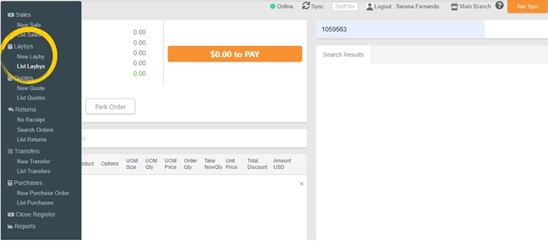
Select the menu icon in the top left, and from the Laybys section, select List Laybys.
-
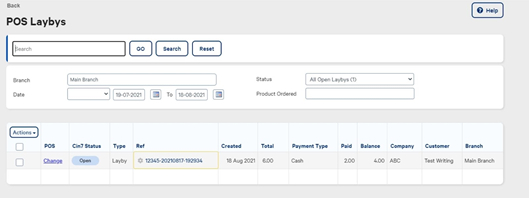
Search for the specific layby, then select its Ref.
-
Hover over the Actions button, then select Cancel Layby And Convert To Store Credit and select OK.
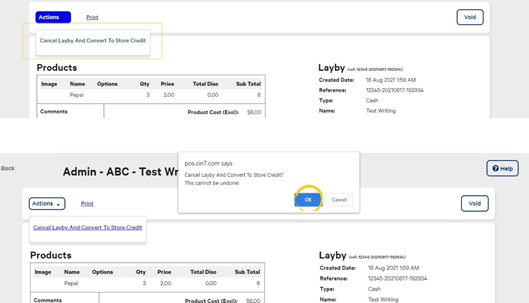
A credit note will be created with the value of the balance paid.
Void a layby
It is likely that some laybys will expire before the remaining balances are paid. In this situation, the customer forfeits the money paid.
- Select the menu icon in the top left, and from the Laybys section, select List Laybys.
- Search for the specific layby, then select its Ref.
- Select Void.
The Layby will be cancelled and have the status Void.
FAQs
Can I cancel a Layby and provide a refund instead of store credit?
You can cancel a Layby and provide a refund, but it requires you to make a fake sale and refund it.
- Create a store credit by canceling the layby.
- Create a sales order for a non stock product at no cost.
- Change the unit price for that non stock product to the value of the store credit.
- Sell the item and apply the store credit to bring the total to $0.
- Return the non stock product and manually clear the store credit if it was applied as a discount.
- Refund the customer.
Can I apply store credit to a cash customer?
Store credit can't be applied to cash customers. Store credit is only an option for transactions linked to a particular customer. Either link the transaction to an existing customer or create a new customer in the CRM.
- Zendesk publishing.4.log-2014405138.zip30 KB
- Zendesk publishing.4.log-2014405138.zip30 KB
- Zendesk publishing.4.log-2014405138.zip30 KB
- Zendesk publishing.4.log-2014405138.zip30 KB
- Zendesk publishing.4.log-2014405138.zip30 KB
- Zendesk publishing.4.log-2014405138.zip30 KB
- Zendesk publishing.4.log-2014405138.zip30 KB
- Zendesk publishing.4.log-2014405138.zip30 KB
- Zendesk publishing.4.log-2014405138.zip30 KB
- Zendesk publishing.4.log-2014405138.zip30 KB
- Zendesk publishing.4.log-2014405138.zip30 KB
- Zendesk publishing.4.log-2014405138.zip30 KB
- Zendesk publishing.4.log-2014405138.zip30 KB
- Zendesk publishing.4.log-2014405138.zip30 KB
- Zendesk publishing.4.log-2014405138.zip30 KB
- Zendesk publishing.4.log-2014405138.zip30 KB
- Zendesk publishing.4.log-2014405138.zip30 KB
- Zendesk publishing.4.log-2014405138.zip30 KB
- Zendesk publishing.4.log-2014405138.zip30 KB
- Zendesk publishing.4.log-2014405138.zip30 KB
- Zendesk publishing.4.log-2014405138.zip30 KB
- Zendesk publishing.4.log-2014405138.zip30 KB
- Zendesk publishing.4.log-2014405138.zip30 KB
- Zendesk publishing.4.log-2014405138.zip30 KB
- Zendesk publishing.4.log-2014405138.zip30 KB
- Zendesk publishing.4.log-2014405138.zip30 KB
- Zendesk publishing.4.log-2014405138.zip30 KB
- Zendesk publishing.4.log-2014405138.zip30 KB
- Zendesk publishing.4.log-2014405138.zip30 KB
- Zendesk publishing.4.log-2014405138.zip30 KB
- Zendesk publishing.4.log-2014405138.zip30 KB
- Zendesk publishing.4.log-2014405138.zip30 KB